
News : The 2026 absence study published by Malakoff Humanis on 9 June 2026 exposes a gap that is hard to ignore: the level of concern French companies express about absence has never been higher, at 63 %, yet more than one company in two, 55 %, has deployed no action at all to address it, and prevention is embedded in only 29 % of companies. Worry, in other words, is progressing faster than action, and that is exactly the space in which decorative wellbeing thrives (Malakoff Humanis, 2026 absence study, 9 June 2026).
I am writing for HR directors, owner-managers of smaller companies and managers who have a wellbeing budget and a doubt: is what I am funding actually changing anything? This is an opinion piece, fed by what I observe on assignment. You will find a way of reading the subject, a table for sorting your initiatives, and one question to ask before the next quote lands on your desk.
Wellbeing at work: my answer in a few lines
Wellbeing at work is not decided in the extras around the work, but in the work itself: workload, meaning, recognition, autonomy and the quality of working relationships. A table football table or a yoga class does no harm; it becomes harmful when it stands in for a prevention policy.
The table football table is not the problem
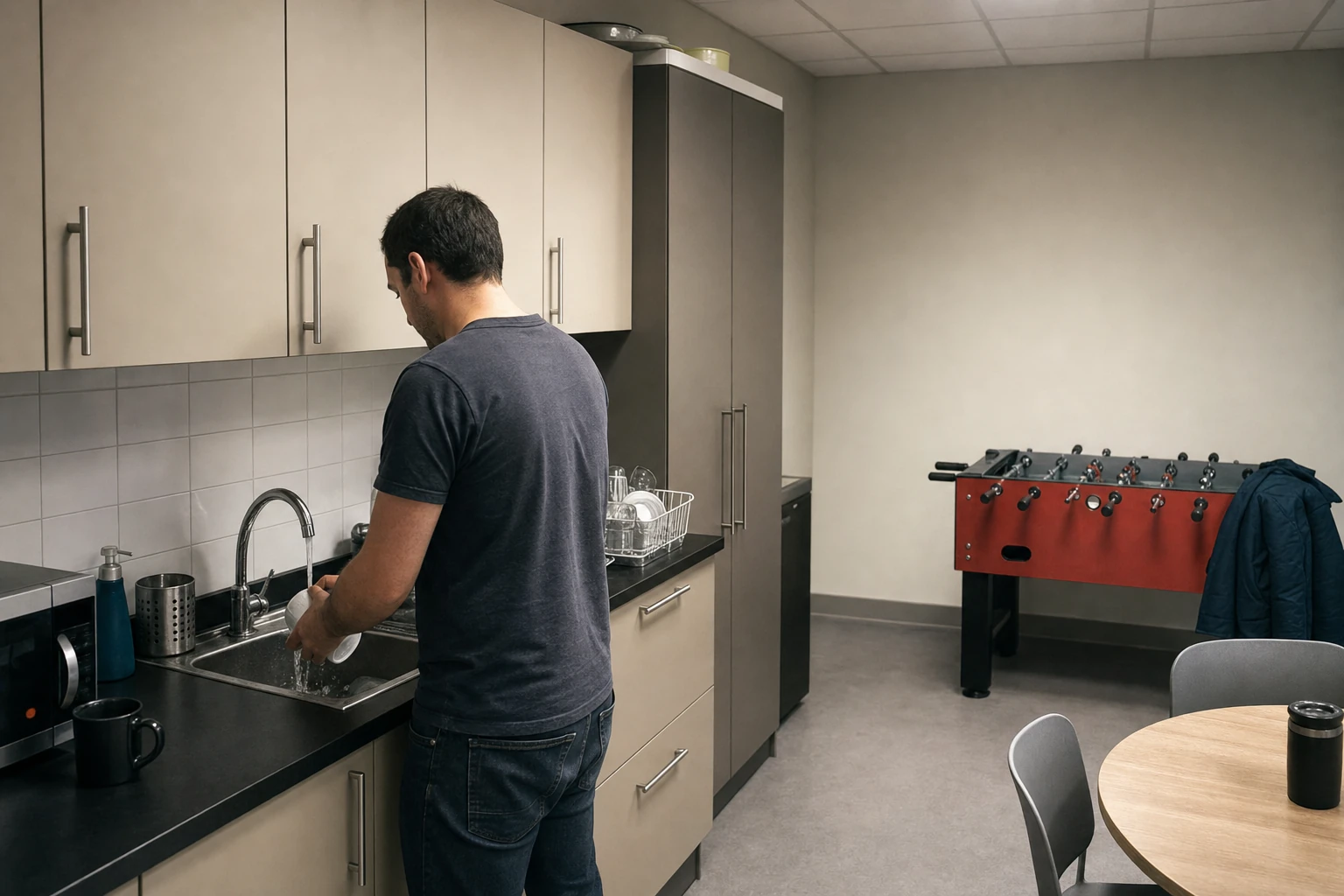
Let me clear the accusation out of the way first. When a company installs a table football table or opens a yoga class on Thursday lunchtimes, it is not trying to lull its employees. It is doing what it knows how to do, with the means at its disposal: actions that are quick to decide and immediately visible. Nothing contemptible in that.
In the smaller industrial companies where I work, I regularly see a coffee corner set up in the workshop do more for working relationships than three departmental meetings: people who never spoke to each other start speaking. The perk becomes useful when it opens a conversation; it is worth nothing when it replaces one.
So I am not asking anyone to throw out their table football table. What I contest is not the good faith behind these initiatives: it is the order of priorities.
When wellbeing at work stands in for prevention
The tipping point comes when the wellbeing initiative becomes the company’s answer to an organisational problem. A team is overloaded, two departures have not been replaced, the deadlines have not moved, and the answer amounts to a stress management workshop. The workshop is not bad, it is beside the point: it offers to bear a situation better that nobody has planned to change.
What strikes me when I work on these subjects is that the wellbeing initiative is almost always decided higher up than the problem it claims to treat. The people concerned discover it along with the invitation, and they usually already hold the answer to the question nobody asked them.
That shift produces two effects. Responsibility moves onto the individual: if you attended the training and you still break, then the problem must be you. And the causes stay intact, producing the same effects one notch lower down, on the people who speak up least.
The distance from a genuine prevention process sits right there: the process described by the French national research and safety institute, the INRS (in French), and by the French Ministry of Labour (in French) for psychosocial risks starts from how work is organised, not from the extras.
Then there is the legal angle, which I set down as a general marker. Article L. 4121-1 of the French Labour Code (in French) requires the employer to take the measures necessary to ensure safety and protect the physical and mental health of workers; article L. 4121-2 (in French) sets out the general prevention principles, one of which is adapting the work to the person; article R. 4121-1 imposes the single risk assessment document. None of them mentions social activities; all of them talk about organisation. On a specific case, have it validated by an employment lawyer or by your occupational health service: I am an HR professional, not a lawyer.
Mental load at work appears in no job description
If only one subject could be kept, it would be this one. Mental load at work is not the number of tasks: it is the invisible load that comes with them. Coordinating, anticipating, remembering, chasing, arbitrating between contradictory demands, staying available. It appears on no job description and takes up a considerable share of the day.
Concretely, these are the situations nobody counts:
- holding in mind what others will forget, and chasing it at the right moment;
- holding two contradictory priorities given by people who do not talk to each other;
- anticipating someone’s reaction before sending them a message;
- staying reachable just in case: availability costs even when nothing happens;
- absorbing the jolts, the meeting that displaces everything else.
This is the gap the French national agency for the improvement of working conditions, the Anact, describes between prescribed workload and actual workload (in French): what was asked for on one side, what it took to get there on the other.
The question that comes up most often when I support frontline managers is not “how do I manage my time better”, it is “how am I supposed to hold all of this in my head”. Nobody has told them that this part of the job counts, and it appears in no annual appraisal.
I see it weigh particularly heavily in support functions, whose job consists of absorbing the disorder produced elsewhere. No yoga class brings it down. What does bring it down: clarifying who decides, reducing the number of people someone has to deal with, stabilising priorities beyond the current week, protecting blocks of time free of interruption, stopping something whenever something is added. Organisational decisions, not gestures of consideration.
Where my role stops. I am an HR professional and a trainer, neither a doctor nor a psychologist. Nothing I write here allows anyone’s state of health to be characterised or a diagnosis to be made. For an individual situation, the routes are the occupational physician, the treating doctor or a psychologist, and the official directory of registered psychologists under the French Mon soutien psy scheme is where to find one. In case of immediate danger in France, call 15. Faced with psychological distress or suicide risk, 3114, the French national suicide prevention line, is free and open 24 hours a day, seven days a week.
The five levers that actually count
Here are the five levers I work on as a priority. None of them is spectacular; all of them touch the real work.
1. Workload
Workload is volume, but also pace, predictability and the mental load described above. A sustainable workload is not a light one: it is a workload whose limits are known and can be discussed. The marker of maturity is having somewhere to say “this does not fit”.
2. Meaning
Nothing philosophical here: I know what my work is for, I see the result, I understand the decisions. Loss of meaning rarely comes from a badly worded purpose statement, but from work that is obstructed: procedures that force people to do a poor job, indicators that reward the opposite of the instruction.
In career reviews, what I hear most often is not “I want to change career”, but “I cannot work like this any more”. The nuance matters: in the second case, it is not the job that is at issue, it is the way work is organised around the person.
3. Recognition
Recognition does not come down to pay, even though it often starts there. It is also the fact that the real work is seen: what had to be solved for the result to look simple. A generic thank you in a plenary session recognises nothing; a precise sentence recognises a great deal.
4. Autonomy
This is the room for manoeuvre people have over how they do their job: the order of tasks, the timing, the method, the possibility of declining a request. The most underestimated lever: it costs nothing financially, but it means giving up control over details that are reassuring.
5. The quality of working relationships
Support from colleagues and from the manager absorbs an enormous amount of difficulty. That is where training finds its place, alongside work on the organisation and not instead of it. Equipping teams to spot signs of difficulty is useful: that is the purpose of mental health first aid training, whose limit I always restate: a first aider signposts, and does not treat. To open the subject collectively without stigmatising anyone, I also run a workshop for talking about mental health at work.
What gets put in place, what it treats, and the question that should have come first
Here is the grid I use in scoping. The right-hand column is the one that always gets skipped.
| What gets put in place | What it actually treats | The question that should have come first |
|---|---|---|
| Table football, break-out corner, fruit baskets | Comfort. Neither workload nor organisation. | Do people have the time to use it, and the right to take that time? |
| Yoga classes, stress management workshops | The individual capacity to absorb, not what produces the pressure. | What is it in the organisation that makes that absorption necessary? |
| After-work drinks, team offsites | Informal bonds, provided they do not encroach on personal time. | Do people talk to each other during work, or only afterwards? |
| Outsourced listening line | Individual support downstream, once the difficulty has set in. What is said there is strictly confidential: no named situation ever reaches the employer. | Is an anonymous, aggregated report planned, where the volume allows one? |
| Right-to-disconnect charter | The stated norm, not the actual practice. | Who writes at 10 pm, and what happens if nobody replies? |
Look at the middle column: none of these initiatives is useless, and none of them treats a cause. On their own, therefore, they cannot constitute a prevention policy. The causes sit where workplace stress is generated.
How I decide before funding an initiative
Before funding anything under the wellbeing heading, I ask a single question:
Which work problem is this initiative the answer to, and who formulated that problem?
If the answer starts with “it is good for the image” or “everyone else does it”, the initiative can stay in the budget, but as comfort, not as prevention. Then, four steps:
- Name the problem in one factual sentence: what is happening, since when, for whom, with what observable consequence.
- Ask the people living it. Not a thirty-item questionnaire: two hours with the team, about the real work, facilitated by someone with no stake in the answer.
- Place the initiative: does it treat the cause, the symptom, or the capacity to absorb the symptom? All three are legitimate; confusing them is not.
- Decide what stops. An initiative added on top of an unchanged workload is one more thing to carry.
One rule to close on: if an initiative cannot be attached to any of the five levers, do not count it in your prevention policy.
What this article does not cover
- It is an opinion piece grounded in my field experience, not a literature review.
- It replaces no organisational diagnosis: the five levers do not carry the same weight depending on the trade and the size of the company.
- It does not deal with individual situations, which belong to the occupational physician, the treating doctor or a psychologist.
- It does not deal with harassment or established conflict, which call for a specific procedure.
- The legal markers quoted are general: on a specific case, the right contact remains an employment lawyer or your occupational health service.
FAQ
Should the table football table be removed?
No. I have never seen an organisation improve because it took away something enjoyable. The table only becomes a problem if it features in the company’s official answer to an identified organisational risk. Keep it in the comfort budget, and build alongside it an answer that touches workload, meaning and autonomy.
What is mental load at work?
It is the invisible part of the activity: coordinating, anticipating, memorising, chasing, arbitrating between contradictory demands and staying available. It is not measured in numbers of tasks and appears on no job description. It weighs above all on frontline managers and on support functions, whose job consists of absorbing the disorder produced elsewhere.
Is wellbeing at work a legal obligation?
The word “wellbeing” is not the way into the law. The employer is bound by a duty of care: article L. 4121-1 of the French Labour Code requires them to take the measures necessary to ensure safety and protect the physical and mental health of workers, and article R. 4121-1 imposes the single risk assessment document. On your own situation, have it validated by a specialist adviser.
Where do you start with a small budget?
With what costs nothing: listening to the real work. Two hours with a team, facilitated by someone with no stake in the answer, produce more information than an annual survey. Then pick a single irritant, the one everybody mentions, and deal with it completely. One problem solved beats five open worksites.
How do you know whether an initiative achieved anything?
Look at whether the work changed, not at whether people enjoyed the moment. The signals I watch: can workload be discussed in a meeting, do priorities hold beyond the week, do the trade-offs come back down the line, how are departures and sick leave moving. A workshop’s satisfaction score measures the workshop, never the organisation.
What I take away
Wellbeing at work cannot be declared and cannot be bought off a catalogue. It plays out in the workload people are given, the meaning made visible, the recognition put into words, the autonomy granted and the quality of the relationships made possible. The rest is comfort, and comfort is a good thing as long as it does not take the place of prevention. To look into a specific situation, write to me: I prefer to start with a call and with your real irritants.
Sources
- Malakoff Humanis, press release, 2026 absence study, Paris, 9 June 2026. newsroom.malakoffhumanis.com
- French Labour Code, article L. 4121-1, Legifrance, accessed 2 September 2026. legifrance.gouv.fr
- French Labour Code, article L. 4121-2, Legifrance, accessed 2 September 2026. legifrance.gouv.fr
- INRS, “Prevenir les risques psychosociaux. Ce qu’il faut retenir”, accessed 2 September 2026. inrs.fr
- French Ministry of Labour and Solidarity, “Risques psychosociaux”, accessed 2 September 2026. travail-emploi.gouv.fr
- Anact, “Comprendre, gerer et reguler la charge de travail”, accessed 2 September 2026. anact.fr
- French health insurance, Mon soutien psy, directory of registered psychologists, accessed 2 September 2026. monsoutienpsy.ameli.fr
- 3114, French national suicide prevention line, 24 hours a day, seven days a week. 3114.fr